
Explore our premium product portfolio featuring high-reliability HART to Modbus gateways, smart RTU converters, and fieldbus communication units direct from China's leading supplier.
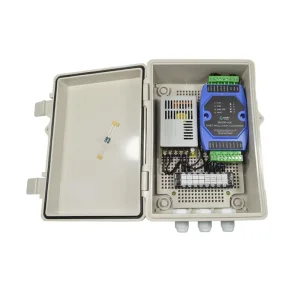
Intelligent protocol converter designed for direct conversion of HART sensor signals to RS485 Modbus-RTU registers for seamless PLC integration.
View Details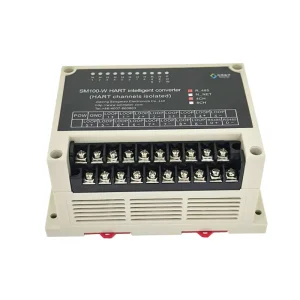
Multi-channel gateway designed for centralized data collection from up to 8 HART smart transmitters over Modbus RS485 network topology.
View Details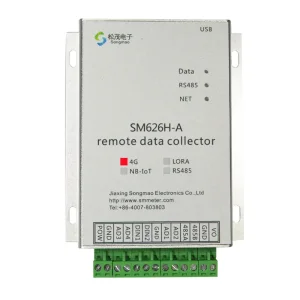
Industrial-grade 4G/GPRS telemetry node designed to transmit Modbus RTU protocol data wirelessly to remote SCADA platforms.
View Details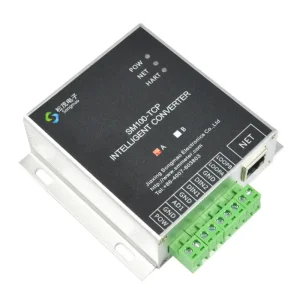
High-performance industrial-grade Ethernet interface module transforming field HART parameters into Modbus TCP/IP protocols.
View Details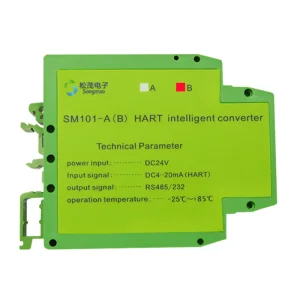
Compact and rugged industrial protocol adapter designed to establish robust communication loops between legacy HART field devices and RS485 systems.
View Details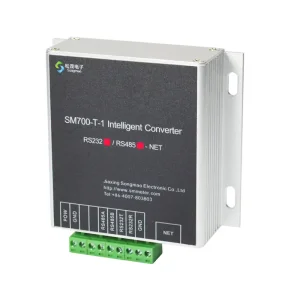
Industrial serial device server translating classic EIA-485 / EIA-232 serial packets into standard TCP/IP socket structures.
View Details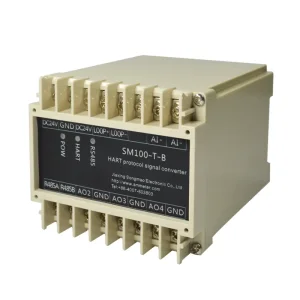
Provides concurrent analog loop isolation and digital network access, converting dynamic HART variables to isolated 4-20mA and Modbus-RTU outputs.
View Details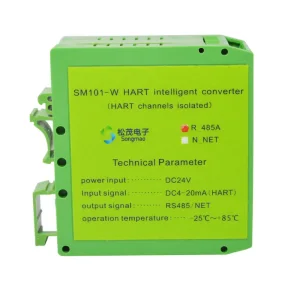
Heavy-duty gateway designed to streamline the commissioning and maintenance of HART process sensors over Modbus networks.
View DetailsFounded in 2007, Jiaxing Songmao Electronics Co., Ltd. has established itself as an authoritative pioneer in the global field of industrial communication interface technologies. Driven by persistent engineering innovation, our organization focuses on designing, manufacturing, and supplying industrial-grade HART protocol converters, Modbus RTU/TCP gateways, and smart telemetry data collectors.
Over the span of 18+ years, we have scaled our R&D capacities to engineer solutions that bridge legacy analog field instrumentation with modern, cloud-based Industrial Internet of Things (IIoT) frameworks. Our hardware integrates seamlessly with distributed control systems (DCS), programmable logic controllers (PLCs), and human-machine interfaces (HMIs) from premier global suppliers, guaranteeing robust data transmission in high-electromagnetic-noise factory environments.

Why Fortune 500 automation enterprises choose Chinese manufactured industrial communications hardware for critical infrastructure deployments.
Our manufacturing facility in Jiaxing utilizes high-precision automated SMT placement lines. This guarantees flawless soldering of miniature components, low impedance paths, and enhanced structural durability of PCB assemblies to withstand severe vibrations in heavy industrial environments.
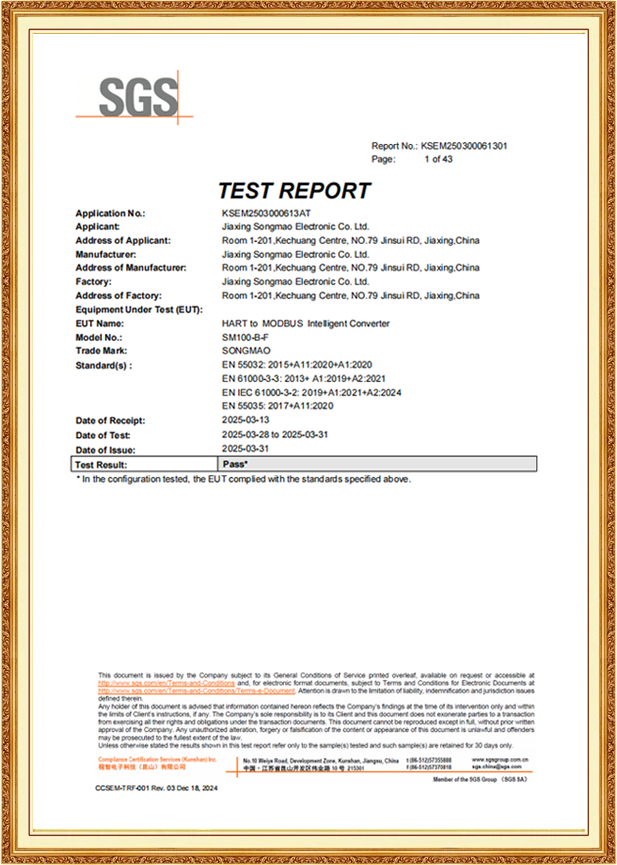
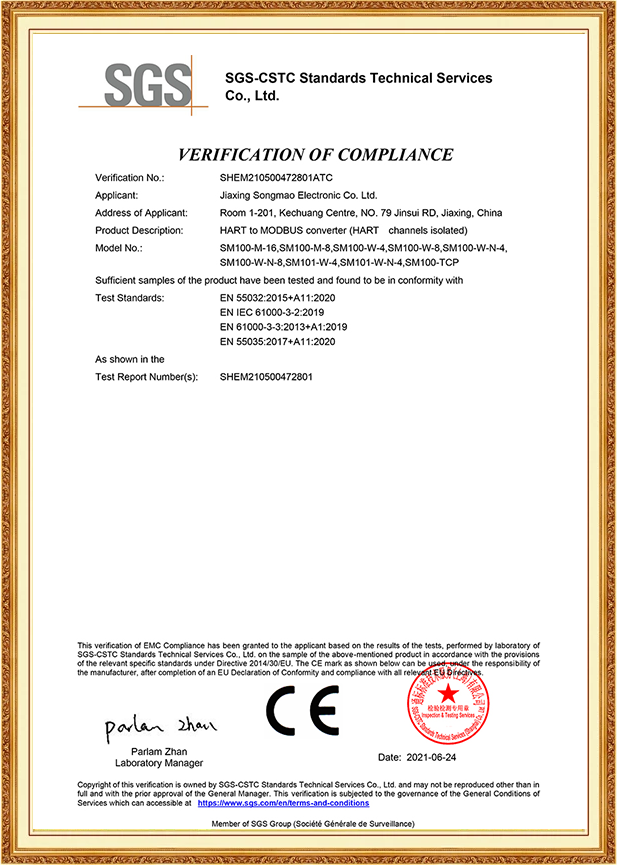
All Songmao protocol converters undergo systematic EMC testing, electrostatic discharge (ESD) immunity trials, and high-voltage surge simulation tests. This ensures our HART and Modbus gateways operate without signal degradation close to high-power frequency inverters.
By bypassing third-party trading entities, our clients collaborate directly with original firmware developers. We offer tailoring of Modbus register mappings, implementation of custom baud rates, and specialized enclosure engineering to meet extreme ATEX explosion-proof requirements.
Located in the heart of China's electronics ecosystem, we benefit from immediate access to qualified, ISO-certified raw components. This supply chain integration translates to reduced manufacturing lead times and optimized pricing for wholesale distribution.
Every single batch of our HART to RS485 converters (e.g., SM100-B-H) and Modbus TCP/IP modules (e.g., SM100-TCP) undergoes a battery of quality verification processes. Before shipment, units undergo 72-hour continuous burn-in tests inside thermal cycling chambers operating from -40°C to +85°C. This eliminates infant mortality failure states, confirming field reliability. Our testing suite evaluates input-to-output galvanic isolation ratings (exceeding 1.5KV AC), protecting upstream PLCs and telemetry networks from ground-loop damage and voltage spikes.
As the fourth industrial revolution (Industry 4.0) accelerates, the role of protocol converters transitions from basic physical-layer conversion (e.g., RS232/RS485 to TCP) to complex edge computing interfaces. The modern smart factory demands real-time process visibility, which requires extracting diagnostic variables hidden within analog instrument loops.
HART (Highway Addressable Remote Transducer) is the most widely deployed protocol for smart field instrumentation. Historically, accessing diagnostic variables required hand-held calibrators. With the emergence of advanced hardware like our SM100-TCP HART to Ethernet Data Acquisition Module, plants can map HART dynamic parameters directly into Ethernet-based control systems (like Modbus TCP/IP, EtherNet/IP, or PROFINET). This integration facilitates predictive maintenance, tracking parameters like sensor drift, ambient temperature spikes, and valve travel degradation.
Remote process monitoring—such as natural gas pipelines, deep-well water tables, and district heating distribution networks—historically relied on expensive satellite links or complex wired installations. The rise of multi-band GPRS and LTE-M telemetry networks (embedded in products like our SM626H-A All-Netcom Data Collector) allows remote devices to act as intelligent edge servers. These devices poll instruments locally via Modbus RTU, package the data, compress it, and transmit it directly to cloud architectures via MQTT or HTTPS protocols, bypassing intermediate PLCs.
With industrial systems increasingly connected to corporate IT networks, security is paramount. China's leading converter manufacturers are responding by incorporating physical isolation barriers, hardware watchdogs, and encrypted transport protocols. Maintaining isolated sub-networks prevents malware from pivoting from general office networks down to physical actuators and control loops.
Providing robust, field-tested communication architectures across critical global utility and processing industries.

Interfacing HART downhole flow meters and pressure transmitters with centralized PLC racks over long-distance RS485 daisy-chains. Intrinsically safe designs for hazardous zones.
Learn More
Collecting thermodynamic variables and heat-meter diagnostics through serial to Ethernet modbus hubs. Facilitates balancing algorithms in urban utility grids.
Learn More
Low-power telemetry configurations integrating multi-variable flow computers via solar-powered GPRS/4G remote data collectors for continuous pipeline leakage diagnostics.
Learn More
Interfacing HART smart electromagnetic flowmeters and liquid analyzers with centralized PLC infrastructure via Modbus-TCP and isolated serial converters.
Learn More
Integrating stack-emission gas analyzers, dust monitors, and meteorological sensors into unified industrial data acquisition modules for environmental agency reporting.
Learn MoreWhen system integrators design process automation networks, managing protocol conversion points dictates system stability. Signal degradation, timing conflicts, and incorrect packet formatting can halt entire process lines. A standard architecture typically features three key communication layers:
Analog field instrumentation—such as temperature controllers, Coriolis flowmeters, and smart valve positioners—relies on 4-20mA loops overlaid with Bell 202 FSK digital signals. A primary design challenge is extracting these digital variables without interfering with the analog loop signal. Our converters feature high input impedance (typically >250 Ohms dynamic resistance) to read HART packets cleanly without causing analog current drops.
This is where physical translation occurs. Hardware like the SM101-B HART to Modbus Converter acts as a master node on the HART loop, continuously polling parameters like primary variable (PV), secondary variable (SV), tertiary variable (TV), and quaternary variable (QV). These dynamic variables are stored in internal memory blocks, which are mapped to standard Modbus holding registers (e.g., 40001 to 40020). Modbus-RTU masters (like PLCs) can retrieve this compiled digital data using standard function codes, reducing HART polling cycle delays.
Once converted to RS485 Modbus RTU, serial data can travel up to 1,200 meters. For integration with SCADA or cloud analytics platforms, serial data is routed through gateways like the SM700-T-1 (RS485 to Ethernet). This converts serial Modbus frames into TCP packets, enabling data access over standard CAT6 Ethernet cable runs or wireless networks.
Complete your automation network deployment with industrial-grade transmitters, multivariable converters, and high-density interface adapters.
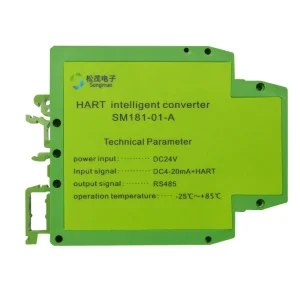
Smart instrument transmitter converting raw analog loop currents and HART variable registers into industrial RS485 communication lines.
View Details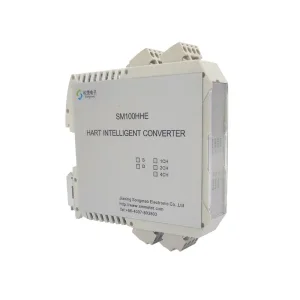
High-performance processing unit designed to mount directly inside smart transmitter enclosures for direct-to-digital conversions.
View Details
Engineered for long-distance data transmission, this module converts 4-20mA signal loops to high-speed RS485 Modbus networks.
View Details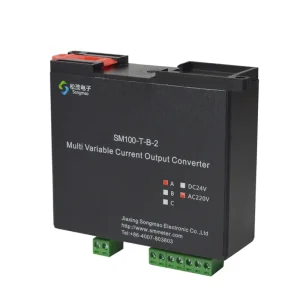
Designed for system integration, this module maps analog process loops to standard digital Modbus registers with minimal latency.
View Details
Dual-purpose gateway supporting both serial RS485 and Modbus-TCP protocol conversions for complex industrial automation grids.
View Details
Highly stable industrial-grade multiplexer designed to interface multiple HART field devices with MODBUS systems.
View Details
Rugged, rail-mounted acquisition system transmitting HART instrumentation data directly to local Area Networks (LAN) over TCP/IP.
View Details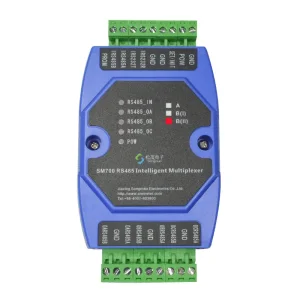
Dynamic serial bus interface designed to streamline device communications and diagnostics in multi-drop RS485 network layouts.
View DetailsSourcing hardware for critical industrial networks requires strict evaluation criteria. A protocol converter failure can disrupt production lines, leading to significant down-time costs. Global procurement managers should assess the following key areas during supplier evaluation:
Field installations expose hardware to ground loop currents and high common-mode voltages. Industrial-grade converters must feature robust galvanic isolation (typically 1.5KV or 3KV DC isolation) between the power input, RS485 bus, and HART loops. Ask suppliers for isolation barrier schematics and test certification records to ensure adequate protection.
Advanced RS485 systems require dynamic baud rates (ranging from 1200 bps up to 115200 bps). High-quality converters incorporate automatic baud rate detection and packet packaging algorithms to minimize data transmission latency. Ensure the supplier's firmware supports configurable response times to prevent PLC polling timeouts.
Determine whether field installations require standard DIN-Rail mounting (ideal for control cabinets), panel installations, or direct-mount PCB boards for integration into smart instrument housings. Rugged metallic enclosures offer superior heat dissipation and shielding against electromagnetic interference compared to low-cost plastic options.
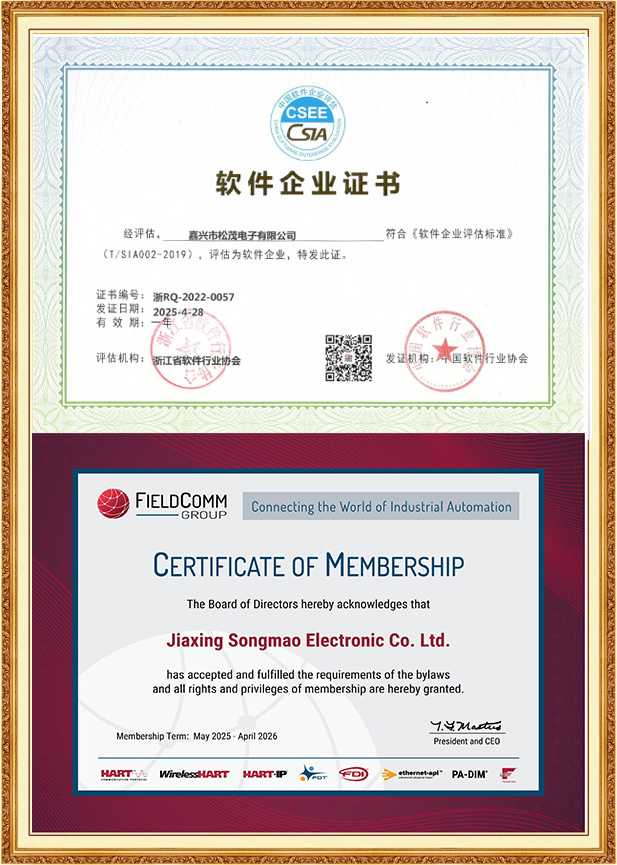
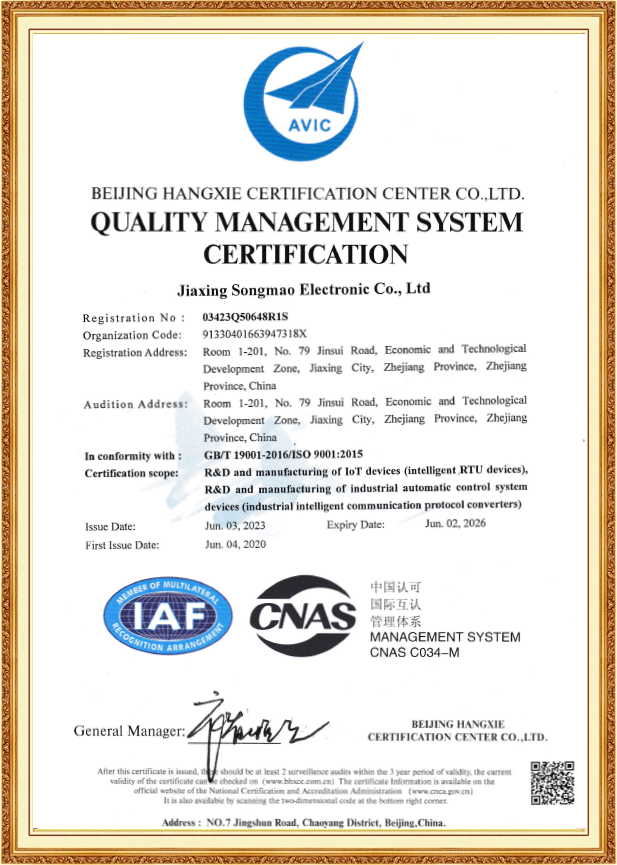
Our manufacturing and engineering design practices comply with international standards, ensuring safe and reliable operation in heavy industrial facilities.




Detailed walkthroughs on configuring, connecting, and troubleshooting standard industrial communication protocols.
Modbus TCP/IP maps standard Modbus RTU frames directly into TCP/IP ethernet packets. To establish connection, configure the gateway (e.g., our SM100-TCP or SM700-T-1) with a static IP address within the local network range (e.g., 192.168.1.100). The standard communication port for Modbus TCP/IP is Port 502.
Ensure the subnet mask matches the master PLC (typically 255.255.255.0). Using RJ45 Cat6 cables, link the gateway to the network switch. Once connected, register addresses map directly to memory addresses. The standard TCP socket layer handles error correction, improving transmission reliability compared to traditional serial networks.
Developed in 1979 by Modicon, Modbus remains a widely used protocol in industrial automation. Operating on a master-slave architecture, only the master node (typically a PLC) can initiate requests. Slave devices respond with data or confirm actions based on the received commands.
The protocol operates via standard function codes, such as 03 (Read Holding Registers) and 06 (Write Single Register). Modbus RTU uses RS485 differential signaling, supporting up to 32 nodes on a single physical segment without repeaters, making it a cost-effective choice for industrial field buses.
Modbus Poll is an industrial software utility used to simulate master node requests during commissioning and troubleshooting. It allows engineers to send custom function codes directly to connected slave devices via RS485 serial adapters or Ethernet ports.
Using Modbus Poll, engineers can read raw register values, monitor communication error rates, and verify that variables map correctly to target addresses. This tool helps confirm that gateways and converters are correctly configured before connecting them to the main PLC or SCADA system.
A HART Modem acts as the bridge between configuration software (like Pactware or Rosemount Radar Master) and field instruments. Connection requires wiring the modem's terminals in parallel with the instrument's loop terminals or across a 250 Ohm resistor on the 4-20mA loop.
The modem uses FSK technology to overlay digital communication signals on top of the analog current loop. Ensure a minimum loop resistance of 250 Ohms is present in the circuit; without this impedance, the digital high-frequency signal will be attenuated, preventing successful communication.
Technical guidance and product specifications for system engineers and procurement professionals.