
2026 Top HART to Modbus Gateway Types for Buyers?

Time:2026-10-02 Author:Madeline
0%

Industrial plants are modernizing legacy instrumentation without replacing every transmitter, loop, or control cabinet. That practical tension makes the Hart To Modbus Gateway an important buying category for 2026. HART preserves analog signaling and device diagnostics, while Modbus connects those signals with PLCs, RTUs, SCADA platforms, and building systems.

Industry research supports this direction. ARC Advisory Group’s industrial networking research continues to identify brownfield integration, protocol convergence, and asset visibility as major automation priorities. MarketsandMarkets’ Industrial Internet of Things reports also emphasize connected sensors, edge processing, and interoperability across mixed-generation equipment. These reports discuss broader gateway and networking markets, however. They do not isolate every HART-to-Modbus product segment. Buyers should avoid treating headline market forecasts as direct product demand.

The strongest 2026 gateway choices will likely include standalone DIN-rail converters, multi-channel HART multiplexers, Ethernet-enabled gateways, and edge gateways with local diagnostics. Each type serves a different cabinet reality. A small water station may need four isolated channels. A refinery skid may require dozens, redundant power, and clear fault records. Firmware support matters. So do terminal design, electrical isolation, polling speed, and transparent diagnostic handling.

A gateway is not automatically a solution.

Field experience shows that the cheapest unit can create hidden costs through unstable polling, incomplete command support, or difficult commissioning. The best selection process therefore compares protocol coverage, HART revision support, Modbus RTU or TCP options, cybersecurity controls, environmental ratings, and vendor documentation. This article examines the leading gateway types for 2026 buyers, while acknowledging one uncomfortable point: no single architecture fits every aging plant.
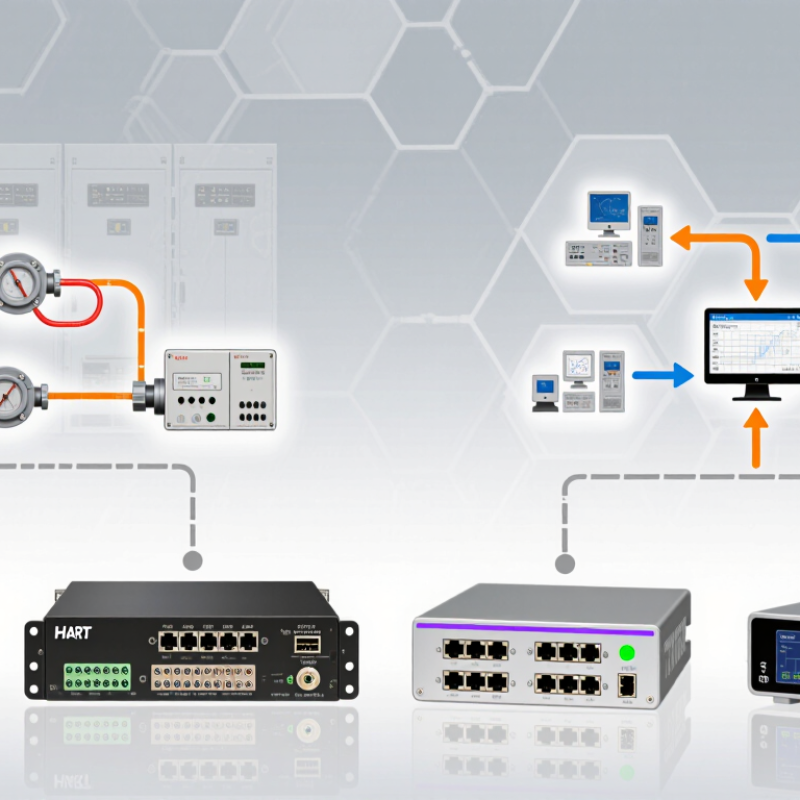
2026 Top HART to Modbus Gateway Types for Buyers?

What Is a HART to Modbus Gateway and How Does It Work?

A HART to Modbus gateway connects smart field instruments with a PLC, RTU, or monitoring system. It translates HART digital communication into Modbus RTU or Modbus TCP data. The 4–20 mA signal usually carries the main process value. HART adds digital information over the same wires.

The gateway polls each instrument through its HART address. It reads values such as pressure, temperature, sensor status, and calibration details. Then, it places this information into Modbus registers. A control system can read those registers using a familiar polling process. Some gateways use RS-485 ports, while others provide Ethernet connections. DIN-rail units suit control cabinets, and compact units fit smaller panels. Address mapping is important. Poor mapping can make correct data appear confusing.

Tips: Confirm the instrument’s HART revision before purchasing. Check whether the gateway supports burst mode, multidrop wiring, and required diagnostic commands. Test register scaling with a pressure calibrator or loop simulator. Keep cable shielding and grounding consistent. A small wiring mistake can create unstable readings. Also, do not assume every HART variable becomes available automatically; firmware and device description support may limit the data. In field projects, documentation often looks complete, yet one unsupported command can require a workaround.

Which HART to Modbus Gateway Architectures Are Available in 2026?

In 2026, buyers can choose several HART to Modbus gateway architectures, depending on loop count, wiring, and control-system needs. A standalone DIN-rail gateway connects multiple HART instruments and exposes process values through Modbus RTU or Modbus TCP. It suits brownfield plants where existing analog wiring must remain unchanged.

Remote I/O architectures place HART communication inside distributed input modules. They reduce cabinet wiring and support local diagnostics, such as sensor status, loop current, and device identification. PLC-integrated modules offer tighter control-system coordination, but their register mapping may require more engineering effort. Edge gateways add another layer. They can filter HART variables, log maintenance data, and forward selected values to supervisory software. This is useful when operations teams need visibility without changing the main controller.

Tips: Confirm channel capacity, isolation, baud rates, and register formats before purchase. Test one real instrument, not only a simulator. Check whether the gateway supports multidrop loops and transparent pass-through diagnostics. Cybersecurity also matters, especially for Ethernet-connected designs.

No architecture is perfect. A compact gateway may save space but create a single point of failure. Remote I/O can scale well, yet troubleshooting becomes less obvious when modules are spread across cabinets. In field projects, I have seen register assumptions cause more delays than wiring faults. Leave room for signal testing, documentation, and future devices. Configuration should be clear enough for another technician to maintain.

2026 Top HART to Modbus Gateway Types for Buyers

Typical HART loops or devices supported by common gateway architectures. Ranges are representative engineering configurations, not universal protocol limits.

Point-to-point HART uses one device per loop, while multidrop networks commonly support up to 15 devices using addresses 1–15. Multiplexer and aggregation architectures scale by adding channels or network segments.

How Do Single-Channel and Multi-Channel Gateways Differ?

Choosing a HART to Modbus gateway in 2026 starts with channel requirements, not product appearance. A single-channel gateway serves one HART field device through one analog loop. It fits compact panels, test benches, and isolated measurement points.

It is usually easier to wire and commission. Technicians can trace one loop, check its current, and verify each Modbus register. However, expanding later may require more gateways, cabinet space, and network addresses. That hidden cost deserves attention.

Multi-channel gateways connect several HART loops through one communication unit. They reduce panel clutter and can simplify upstream Modbus integration. A cabinet with eight pressure transmitters may need one Ethernet connection instead of eight separate connections. That can improve maintenance visibility.

Yet multi-channel designs demand stronger planning. Engineers must confirm channel isolation, HART command support, scan timing, and register mapping. Eight channels may not update simultaneously. Fast process values can expose this limitation.

Check the update interval. Check diagnostics too.

Single-channel units often make fault isolation clearer. A failed device usually affects one measurement only. With multi-channel equipment, a power fault or configuration error may interrupt several loops. This risk is manageable with isolation, spare capacity, and documented settings.

The best choice depends on loop count, cabinet constraints, response time, and future expansion. In practice, the decision is less tidy. A small project may still benefit from multi-channel hardware, while a critical loop may deserve a dedicated gateway. Engineers should test the actual transmitter, cable length, and Modbus polling behavior before final approval.

What Features Should Buyers Compare Before Selecting a Gateway?

Choosing a HART to Modbus gateway requires more than checking protocol labels. HART Communication Foundation data indicates over 40 million HART-enabled field devices operate worldwide. That scale makes compatibility and expansion important. Buyers should compare single-channel, multi-channel, DIN-rail, and wireless gateway types. A multi-channel unit suits dense control cabinets. A compact single-channel model may fit remote skids better.

Compare HART command support, Modbus TCP and RTU options, polling speed, and register mapping flexibility. Galvanic isolation matters when long cable runs create grounding problems. Look for clear diagnostics, signal-quality records, watchdog functions, and configurable timeout alarms.

IEC 62443 guidance also highlights secure access, controlled firmware updates, and network segmentation. Environmental ratings should match the cabinet, not the brochure. IP ratings, operating temperature, vibration resistance, and power redundancy can decide long-term reliability.

In practice, installation teams often discover that easy configuration matters more than peak data rates. That is worth remembering.

Tips: Ask for a live test with your actual transmitters and PLC. Verify burst-mode handling, unsupported HART commands, and failure recovery. Request a complete register map before purchasing. Check whether configuration software works offline. A gateway that passes data but hides diagnostic status is only partly useful. Also compare total ownership cost, including spare units, engineering time, and future channel expansion. Market forecasts for industrial connectivity continue to show strong growth, but forecasts cannot predict every plant’s wiring problem. Test before committing.

How Can Buyers Match Gateway Types to Industrial Applications?

2026 Top HART to Modbus Gateway Types for Buyers?

How Can Buyers Match Gateway Types to Industrial Applications?

Gateway selection should begin with the plant’s signal path, not the product’s channel count. The HART Communication Foundation reports more than 50 million HART-enabled devices installed worldwide. That installed base makes gradual modernization practical. A single-channel gateway suits a test bench, dosing skid, or one critical pressure transmitter. It keeps wiring simple and limits troubleshooting.

For larger process areas, choose a multi-channel gateway with galvanic isolation, clear diagnostics, and stable polling control. Modbus RTU fits older PLC cabinets and short serial networks. Modbus TCP suits Ethernet-based SCADA systems and distributed control rooms. Remote tanks may need a wireless HART-to-Modbus gateway, especially when trenching is expensive. However, wireless performance depends on metal structures, battery policy, and update intervals. It is not automatically the cheapest choice.

ARC Advisory Group’s 2024 industrial networking research highlights continuing migration toward Ethernet-based architectures, but many plants still operate mixed networks. Buyers should therefore verify register mapping, HART secondary variables, alarm handling, and failure behavior before purchase. A gateway that reads only the primary variable may appear successful during commissioning. It may still hide valuable diagnostics. I have seen specifications overlook response time under heavy polling. That mistake deserves attention. Test the gateway with real instruments, long cable runs, and simulated communication faults before approving deployment.

2026 Top HART to Modbus Gateway Types for Buyers? - How Can Buyers Match Gateway Types to Industrial Applications?

Gateway type HART-side architecture Modbus-side interface Typical channel capacity Best-fit applications Key advantages Main limitations Buyer selection focus
Single-loop HART-to-Modbus RTU converter One point-to-point HART device over a conventional 4–20 mA loop RS-485 using Modbus RTU Usually 1 HART device per converter Skid packages, pilot plants, machine monitoring, and isolated field instruments Simple topology, low integration effort, and suitable for small data sets Limited scalability; requires one interface for each independent loop Loop wiring, power requirements, baud rate, parity, register mapping, and polling time
Multi-channel HART multiplexer gateway Scans multiple HART-enabled analog loops through a multiplexer architecture RS-485 using Modbus RTU, commonly with isolated serial ports Commonly 8, 16, 32, or more loops, depending on the system design Process plants, tank farms, compressor stations, and brownfield asset monitoring Centralized access to secondary HART variables and diagnostics without replacing field instruments Higher configuration complexity and slower access when many devices share the scan cycle Maximum channels, scan time, multidrop support, loop compatibility, isolation, and cabinet space
HART-to-Modbus TCP industrial gateway HART field devices connected through a single-loop interface or multiplexer Ethernet with Modbus TCP Varies from a few loops to a multi-channel HART subsystem PLC, SCADA, DCS, and industrial Ethernet networks in modern facilities Direct Ethernet integration, easier network diagnostics, and convenient connection to supervisory systems Requires suitable Ethernet infrastructure and careful cybersecurity segmentation Dual Ethernet needs, IP configuration, Modbus unit identification, firewall rules, and network redundancy
HART-IP to Modbus gateway HART-IP communication over Ethernet, often connected to remote I/O or a HART device server Modbus TCP or, through an additional interface, Modbus RTU Determined by the connected HART-IP server and network architecture Large plants, distributed maintenance systems, centralized asset management, and Ethernet-based control networks Supports network-based HART access and can reduce long point-to-point serial runs HART-IP availability is required; interoperability and security settings must be verified HART-IP server compatibility, session handling, port configuration, authentication, and data latency
Wireless HART data concentrator to Modbus gateway Receives data from a WirelessHART network through a gateway or network manager Usually Modbus TCP; some installations use Modbus RTU through a serial converter Depends on wireless network capacity and update rate Temporary measurement points, brownfield expansions, remote tanks, and difficult-to-wire assets Reduces signal cabling and enables additional measurements where new wiring is impractical Depends on radio coverage, battery strategy, network planning, and wireless update intervals Wireless coverage, channel planning, battery life, network manager interface, latency, and hazardous-area approvals
Remote I/O HART gateway with Modbus output HART-capable analog input modules communicate with connected field transmitters Modbus RTU or Modbus TCP, depending on the remote I/O coupler Multiple analog input channels, commonly arranged in modular banks New installations, distributed process areas, water treatment, utilities, and packaged equipment Combines signal acquisition, HART diagnostics, and Modbus communication in a modular platform May require replacement or redesign of existing I/O and careful channel-level commissioning I/O density, channel isolation, analog accuracy, power budget, hot-swap capability, and enclosure rating
Intrinsically safe or hazardous-area HART gateway HART signals pass through certified barriers, isolators, or hazardous-area interface modules Modbus RTU or Modbus TCP from the safe-area side Typically a small to medium number of protected loops Oil and gas, chemical processing, pharmaceutical production, and other classified locations Supports compliant integration of HART instruments installed in hazardous locations Certification restrictions can limit installation methods, wiring options, and device combinations Ex certification, entity parameters, galvanic isolation, temperature class, zone or division requirements, and documentation
Protocol gateway with HART diagnostic mapping Reads primary variables, secondary variables, device status, alarms, and selected diagnostic information Modbus RTU or Modbus TCP with configurable register maps Based on the number of connected HART instruments and supported command sets Predictive maintenance, condition monitoring, energy management, and retrofit projects Makes device health and configuration data available to systems that natively understand Modbus Not every HART command or device-specific diagnostic field can be represented uniformly in Modbus registers Supported HART universal and common-practice commands, register documentation, data types, scaling, and exception handling
Buyer matching rule: Select the smallest gateway architecture that satisfies the required loop count, communication distance, update rate, hazardous-area classification, network protocol, diagnostic depth, and future expansion capacity.

FAQS

Which gateway architecture suits an existing plant with unchanged analog wiring?

A standalone DIN-rail gateway usually fits this situation. It connects several HART instruments through existing loops. Process values can reach Modbus RTU or Modbus TCP. Check isolation and cabinet space carefully.

When should a remote I/O architecture be considered?

Remote I/O suits distributed cabinets and larger installations. It can provide sensor status, loop current, and device identification locally. Troubleshooting may become less obvious across multiple cabinets. Leave clear labels and test points.

What is the difference between single-channel and multi-channel gateways?

A single-channel unit handles one HART loop. Wiring and fault tracing are usually simpler. A multi-channel unit connects several loops and reduces panel clutter. Eight transmitters might share one network connection.

Can a multi-channel gateway update every signal simultaneously?

Not always. Scan timing, command support, and polling behavior affect update intervals. Fast process changes may reveal delayed values. Test actual transmitters, not only a simulator.

Which features should buyers compare before purchase?

Compare channel capacity, HART command support, Modbus options, polling speed, and register mapping. Also check isolation, watchdog functions, timeout alarms, and diagnostic records. A complete register map matters.

Why does galvanic isolation matter in gateway installations?

Isolation can reduce problems from grounding differences and long cable runs. It is especially useful in crowded industrial cabinets. Do not trust the brochure alone. Confirm the actual wiring conditions.

What cybersecurity features should an Ethernet-connected gateway provide?

Look for controlled access, secure firmware updates, and network segmentation. Ethernet designs deserve stronger protection than isolated serial links. Keep configuration records offline. Small omissions can become expensive later.

How should a gateway be tested before final approval?

Connect one real transmitter, the intended cable, and the target PLC. Verify register values, diagnostics, polling behavior, and failure recovery. Test unsupported commands and burst-mode handling. Real hardware exposes assumptions.

Conclusion

A Hart To Modbus Gateway converts digital HART communication into Modbus RTU or Modbus TCP data, allowing smart field instruments to exchange information with PLCs, SCADA systems, and industrial monitoring platforms. In 2026, buyers can choose from standalone converters, integrated control-panel gateways, protocol bridges, and network-enabled architectures. These solutions may support single-channel communication for smaller installations or multi-channel communication for larger systems requiring simultaneous access to multiple instruments.

Before selecting a gateway, buyers should compare channel capacity, supported HART and Modbus versions, communication speed, wiring options, isolation, diagnostic functions, configuration methods, environmental protection, and cybersecurity capabilities. The best choice depends on the application: single-channel models suit simple upgrades and individual instruments, while multi-channel or Ethernet-based designs are more suitable for process plants, remote monitoring, and centralized automation. Careful evaluation of compatibility, scalability, installation requirements, and long-term maintenance can help ensure reliable data integration and efficient system performance.

Madeline

Madeline

Madeline is a dedicated marketing professional with a wealth of expertise in our company's core offerings. With a keen understanding of the industry, she brings a unique perspective to her role, consistently delivering high-quality content that highlights the superior aspects of our products. As......